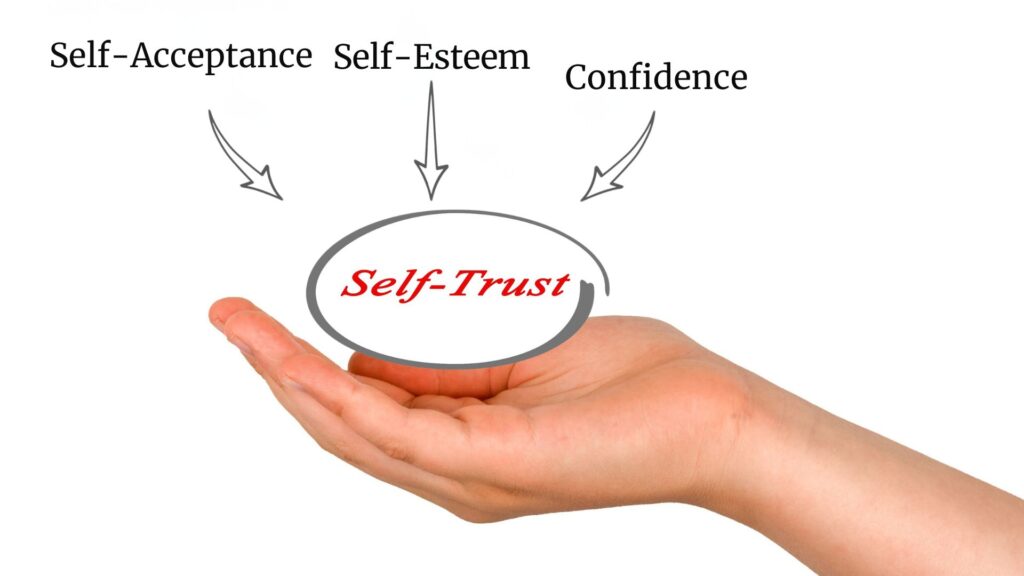

Let me tell you about the most dangerous giant I see sabotaging Kingdom leaders. It’s not fear. It’s not shame. It’s not even imposter syndrome.
It’s broken self-trust. And it’s silently destroying your ability to walk in your calling, stick to your commitments, and build anything that lasts.
Here’s what broken self-trust looks like in real life: You set your alarm for 6am. It goes off. You hit snooze. Again. And again. You promise yourself you’ll start that morning routine. You don’t. You commit to posting on social media three times a week. You post once, then nothing for two months. You tell yourself “this is the week I’m going to stick to my boundaries.” By Wednesday, you’re overcommitted and resentful again. You say you’re going to start that business, write that book, launch that offer. But somehow, you never quite get there.
And with every broken promise to yourself, you’re sending a message to your subconscious mind: “I can’t trust you. You won’t follow through. You never do.”
Proverbs 25:28 puts it bluntly: “Like a city whose walls are broken through is a person who lacks self-control.” In biblical times, a city’s walls were its primary defense against enemies. Without them, the city was vulnerable to attack, invasion, and destruction. When you lack self-control (the ability to keep promises to yourself), you’re living with broken walls. You’re defenseless against the attacks of doubt, discouragement, and defeat. Every broken promise is another breach in your walls, and the enemy knows exactly where to strike.

The Neuroscience of Broken Self-Trust
Here’s what most people don’t understand: Your brain is always listening to what you do, not just what you say. Every time you make a promise to yourself and break it, your brain creates what neuroscientists call a “prediction error.” Your brain predicted: “She said she’d do this.” Reality: “She didn’t do it.”
And when prediction errors happen repeatedly, your brain does something devastating: It stops believing your future predictions. This isn’t just psychology. This is neuroplasticity at work. Your brain literally rewires itself to expect that you won’t follow through.
So when you say “I’m going to wake up early tomorrow,” your brain doesn’t create motivation or commitment. It creates doubt. Because based on past data, you probably won’t. This is why willpower feels impossible. Your brain is working AGAINST you because you’ve taught it not to trust you.
As neuroscientist Dr. Joe Dispenza says, “If you want to create a new future, you can’t do it from your past. You have to break the habit of being yourself.” But you can’t break the habit of being yourself if your brain doesn’t trust that you’re capable of change. Every broken promise reinforces the old pattern. Every kept promise creates a new one.
The Psychological Damage: The Stories You Tell Yourself
But it gets worse. Because broken self-trust doesn’t just affect your behaviour. It affects your identity. Every broken promise becomes evidence for a deeper belief: “I don’t have discipline.” “I’m not the kind of person who follows through.” “I always start strong and quit.” “I’m just not built for consistency.” “Other people can do this, but I can’t.”
And these beliefs? They become the one-liners you repeat to yourself every time you try to do something new. You’re not battling laziness. You’re not lacking motivation. You’re battling the story you’ve told yourself about who you are. And that story was built, brick by brick, with every promise you broke to yourself.
Romans 12:2 tells us, “Do not conform to the pattern of this world, but be transformed by the renewing of your mind.” The Greek word for “transformed” is metamorphoō, the same word used to describe a caterpillar becoming a butterfly. It’s a complete change of form, not just a surface-level adjustment. But here’s the thing: you can’t renew your mind if you don’t trust yourself to think new thoughts and take new actions. Transformation requires trust. And trust is built one kept promise at a time.
How Broken Self-Trust Sabotages Your Kingdom Assignment
Now here’s where this gets serious. Broken self-trust doesn’t just stop you from waking up on time or sticking to a routine. It stops you from obeying God. Because here’s what happens: God gives you an assignment. A clear download. A prophetic word. A vision. And you know it’s Him. You feel it in your spirit. It’s undeniable. But then your brain asks one question: “But can YOU actually do this?” And because you’ve broken so many promises to yourself, the answer your brain gives is: “Probably not.”
So you don’t move. You don’t obey. You don’t step out. Not because you don’t believe God called you. But because you don’t believe YOU can carry what God called you to. This is why you keep asking for more clarity when you already have it. This is why you keep waiting for more confirmation when God already spoke. This is why you keep praying and fasting for breakthrough when the only thing standing between you and your assignment is your inability to trust yourself to steward it.
Think about Moses at the burning bush. God gave him a clear assignment: “Go, I am sending you to Pharaoh to bring my people out of Egypt” (Exodus 3:10). Moses knew it was God. But what was his response? “Who am I that I should go?” (Exodus 3:11). Not “Who are You?” but “Who am I?” Moses didn’t doubt God’s power. He doubted his own capacity to carry what God was entrusting to him. And God’s response? He didn’t give Moses more signs, more confirmation, or more preparation time. He said, “I will be with you” (Exodus 3:12). God was saying: “Stop waiting to trust yourself. Trust Me to work through you.” But Moses couldn’t receive that truth because he didn’t trust himself to obey.

The Subconscious Sabotage
And here’s the most insidious part: Broken self-trust doesn’t just make you doubt yourself. It makes you actively sabotage yourself. Because deep down, your subconscious mind believes: “If I really try and I still fail, that proves I’m not capable.” “But if I don’t try my hardest, I can always say ‘I could have done it if I’d really tried.'”
So you procrastinate. You half-commit. You create circumstances that ensure you can’t fully show up. Not because you’re lazy. Not because you’re afraid. Because your subconscious mind is trying to protect you from the pain of proving that your worst belief about yourself is true. This is self-sabotage. And it’s rooted in broken self-trust.
As I often tell my clients: “You’re not afraid of failure. You’re afraid of trying your hardest and still failing, because then you’d have no more excuses. So you sabotage yourself before you can be disappointed.” This is the giant whispering lies: “Better to not try at all than to try and prove you’re not capable.”
What Broken Self-Trust Costs You
Let me be blunt about what this is costing you:
It’s costing you your routines: You can’t stick to morning routines, workout schedules, or healthy eating habits because you don’t trust yourself to follow through.
It’s costing you your consistency: You can’t show up consistently in your business, your content, your relationships, because you don’t believe you’re “that kind of person.”
It’s costing you your assignments: You can’t step into what God’s called you to because you don’t trust yourself to handle it.
It’s costing you your peace: You’re exhausted from starting over. From feeling like a failure. From wondering why everyone else can “just do the thing” and you can’t.
It’s costing you your calling: Because you were anointed for breakthrough, but you’re stuck in a cycle of broken promises, self-doubt, and sabotage.
And every day you don’t rebuild self-trust is another day you delay your obedience.
How much more are you willing to allow the enemy to take from you?
The Biblical Foundation: Stewardship Requires Trust
Here’s what the enemy doesn’t want you to know: Self-trust isn’t selfish. It’s stewardship. When God entrusts you with a calling, a vision, a ministry, or an assignment, He’s expecting you to steward it. And you can’t steward what you don’t trust yourself to carry.
Look at the parable of the talents in Matthew 25. The servant who buried his talent didn’t do it out of laziness. He did it out of fear. He didn’t trust himself to steward what the master had given him. And what did the master call him? “Wicked and lazy.” Not because he didn’t try hard. But because he didn’t trust himself enough to try at all.
Here’s what’s often missed in this parable: The servant said, “I was afraid and went out and hid your gold in the ground” (Matthew 25:25). He was afraid of failing. Afraid of losing what wasn’t even his to begin with. So he protected himself by doing nothing. And the master’s response? “You wicked, lazy servant!” (Matthew 25:26). The master didn’t call him wicked because he lost money. He called him wicked because he let fear and self-distrust keep him from even trying to steward what was entrusted to him.
That’s what broken self-trust does. It makes you bury your gifts. It makes you hide your calling. It makes you shrink back from what God’s given you to steward. And God’s not calling you to perfection. He’s calling you to faithfulness. But you can’t be faithful if you don’t trust yourself to show up.
How to Rebuild Self-Trust: Start Smaller Than You Think
So how do you rebuild self-trust after years of breaking promises to yourself? You start so small it feels ridiculous. I had a client recently—brilliant, anointed, called—but completely stuck. She couldn’t stick to routines. Couldn’t follow through on commitments. Felt like she was constantly failing herself and it began to seriously impact her stress levels and her mental health. And when we dug into it, we realised: her brain didn’t believe her anymore.
So I told her: “Tomorrow morning, I want you to make your bed. That’s it. Just make your bed.” She laughed. “That’s it? That’s too small.” I said, “Exactly. It has to be small enough that you can’t fail.” Because right now, your goal isn’t transformation. Your goal is to prove to your brain that you can do what you say you’re going to do.
So she made her bed. Granted she missed 3 days in the first week, but then, every morning for 11 days, she made her bed. And something shifted. Not because making her bed changed her life. But because it changed the story her brain was telling her about herself. From: “I never follow through.” To: “I said I’d make my bed, and I did. Almost every day.” That’s a new data point. A new piece of evidence. And when you stack enough of those data points, your brain starts to believe you again. She then asked me for another task because now she believed she could stick to something, and wanted an opportunity to do it again, but this time for the full 14 days. Do you see how this works? Let me break it down.

The Micro-Commitment Strategy
Here’s the framework:
Step 1: Pick ONE micro-commitment.
Something so small you can’t justify not doing it:
- Make your bed
- Drink a glass of water when you wake up
- Write one sentence in your journal
- Pray for 60 seconds before you get out of bed
Step 2: Do it for 7 days. No exceptions.
Not “when you feel like it.” Not “if you remember.”
Every single day for 7 days.
Step 3: Notice the shift.
Pay attention to how it feels to keep a promise to yourself.
Notice the quiet confidence that starts to build.
Notice how your brain starts to trust you again.
Step 4: Add another micro-commitment.
Once the first one is automatic (usually after 2-3 weeks), add another small commitment.
Don’t skip ahead. Don’t try to overhaul your entire life.
Just stack one small promise on top of another.
Why This Works: The Neuroscience of Small Wins
Here’s why this strategy is so powerful: Every time you keep a micro-commitment, your brain releases dopamine. Dopamine is the “reward” neurotransmitter. It tells your brain: “That felt good. Let’s do it again.” But here’s the key: dopamine isn’t released when you achieve a big goal. It’s released when you make progress toward a goal.
So when you make your bed, your brain doesn’t think: “Wow, you made your bed, how groundbreaking.” It thinks: “You said you’d do something, and you did it. That’s progress. That feels good.” And the more you repeat this pattern, the more your brain starts to associate “keeping promises to yourself” with “feeling good.” This is how you rewire your brain to trust you again.

The Spiritual Side: Obedience in the Small Things
But here’s the Kingdom truth underneath all of this: God cares about your obedience in the small things because it reveals whether you’ll obey in the big things. Luke 16:10 says: “Whoever can be trusted with very little can also be trusted with much, and whoever is dishonest with very little will also be dishonest with much.”
This isn’t about God being petty or demanding perfection in minor details. It’s about character formation. In the original Greek, the word for “faithful” is pistos, which means trustworthy, reliable, and true to one’s word. God is looking for people who are pistos. Not perfect. Not flawless. But reliable. Trustworthy. True to their word, even in the small things no one else sees.
You want God to trust you with a ministry, a platform, a business, a movement? Start by proving you can be trusted to make your bed. I know that sounds harsh. But here’s the truth: If you can’t keep a promise to yourself to wake up when your alarm goes off, how will you steward a team, a community, a calling? If you can’t follow through on a simple morning routine, how will you follow through when the assignment gets hard?
Faithfulness isn’t built in the big moments. It’s built in the small, unseen, unglamorous moments where no one’s watching but you. And when you learn to trust yourself in the small things, God knows He can trust you with more. As Jesus said in Matthew 25:21, “Well done, good and faithful servant! You have been faithful with a few things; I will put you in charge of many things.” The pathway to “many things” starts with faithfulness in “a few things.” And faithfulness to God starts with faithfulness to the promises you make to yourself.

The Giant Slayer Strategy: Replace Coping with SLAYING
Here’s what I teach inside Giant Slayer: You can’t dismantle a giant if you don’t trust yourself to follow through on the strategy. You can have the best tools, the clearest plan, the most powerful truth. But if you don’t trust yourself to actually DO it, none of it matters.
This is why so many Kingdom leaders stay stuck. They have the knowledge. They have the revelation. They even have the resources. But they don’t have self-trust. And without self-trust, you can’t execute. You can’t build. You can’t steward.
So inside Giant Slayer, we don’t just identify the giants. We rebuild the foundation of self-trust that makes it possible to slay them. Because you can’t thrive with survival tools. And you can’t slay giants if you don’t trust yourself to show up to the battlefield.
Author and leadership expert John Maxwell says it perfectly: “Small disciplines repeated with consistency every day lead to great achievements gained slowly over time.” But you can’t repeat disciplines with consistency if you don’t trust yourself to follow through. Self-trust is the foundation. Everything else is built on top of it.
Your Next Step: The 7-Day Self-Trust Challenge
Here’s what I want you to do: Pick ONE micro-commitment for the next 7 days. Something ridiculously small. Something you can’t fail at. Examples: Make your bed every morning. Drink a glass of water before coffee. Write one sentence of gratitude. Pray for 60 seconds as soon as you open your eyes, before checking your phone. Say one affirmation out loud when you wake up. Spend 15 minutes studying a bible verse. Keep it real simple.
That’s it. Just one thing. For 7 days. No exceptions. No “I’ll start tomorrow.” No “I forgot.” 7 days. One promise. Keep it.
And watch what happens. Not just in your routine. But in your belief about who you are. Because when you prove to yourself that you can keep a promise, everything changes. Your brain starts to trust you. Your confidence starts to rebuild. Your capacity to steward bigger assignments starts to expand. And the giant of broken self-trust? It starts to fall.
Want to Do This Challenge With Support?
You could do this challenge on your own—and you might see some breakthrough. But there’s something powerful about doing deep inner work in community, with accountability, and with a coach who can help you process what comes up.
And this is just one challenge.
Inside Giant Slayer, we tackle a different emotional giant every month through structured 7-day challenges—Self-Trust, Self-Doubt, Fear, Shame, Perfectionism, People-Pleasing, and more.
Imagine who you’ll be in 6 months after doing the emotionally and spiritually grounding work of slaying a different giant each month—with biblical foundations, real accountability, and a community of powerful Kingdom women behind you.
You’ll get:
✅ Monthly 7-day transformation challenges
✅ Full 8-Module Giant Slayer Course
✅ Twice-monthly Bible studies and monthly roundtables
✅ Quarterly book clubs and Fireside Talks with guest experts
✅ A community of Kingdom women who refuse to stay stuck
You have two choices: do this alone, or join a community of women who are rebuilding self-trust and slaying giants. You are one of us. Come, let’s slay.

The Bottom Line
You’ve been praying for a breakthrough. You’ve been fasting for clarity. You’ve been asking God to open doors. But maybe the breakthrough you need isn’t out there. Maybe it’s in here. In your ability to trust yourself. To keep promises to yourself. To prove to your own brain that you are who you say you are.
Because the truth is: God already gave you the assignment. He already released you into your calling. He already equipped you with everything you need. The only thing standing between you and your breakthrough? Your willingness to trust yourself enough to obey.
Philippians 2:13 reminds us: “For it is God who works in you to will and to act in order to fulfill his good purpose.” God is already working IN you. He’s already given you the will. He’s already given you the ability to act. The question is: do you trust yourself to partner with what He’s already doing?
So start small. Start today. Start with one promise. And rebuild the foundation that makes everything else possible. Because you can’t slay giants if you don’t trust yourself to pick up the stones.
As I tell every client I work with: “Breakthrough doesn’t require perfection. It requires one kept promise at a time.”
Stay sharp and SLAY!.
Coach JJ – Professional Giant Slayer
P.S. You have the framework. Now here’s the truth: most people who read this won’t actually do it. Not because they don’t want to. But because doing it alone is hard. Accountability makes all the difference. Inside the Giant Slayer Community, you’ll complete the 7-Day Self-Trust Challenge with daily support, accountability, and a tribe who understands the battle. Founding Member pricing ends once we hit 25 members. After that, the price increases to $67/month. Lock in the lowest rate now whilst founding spots are available. Let’s slay some giants together.
